
Authentic Communication, Conflict & Emotional Safety
In conscious dating and relationships, green flags are not just about chemistry, attraction, or shared interests. One of the deepest green flags is to feel good in the connection, enjoy their presence and the ability to communicate with honesty, kindness, self-awareness, and emotional responsibility. When getting to know someone, it's beautiful to just explore friendship first and little bit of romance if it feels right, taking it lightly and having fun. Then if something deeper is evolving talking about any questions or techniques highlighted here.
Authentic communication means we are willing to tell the truth without attacking, listen without preparing a defence, and share our feelings without making the other person responsible for fixing them.
“A beautiful relationship is not one without triggers. It is one where both people are willing to meet the triggers with awareness, curiosity and compassion. Being able to hold space to heal what's been stired up. Generally childhood experiences lead to feelings of not being good enough, fear of control, abandonment, not be a priority or rejection. And as we become closer to someone this might become a trigger point.”
Using NVC in Dating & Relationships
Nonviolent Communication, often called NVC, is a simple and powerful way to speak from the heart. It helps us move away from blame and into deeper understanding.
A helpful NVC structure is:
- Observation: What actually happened, without blame or story?
- Feeling: What am I feeling in my body and heart?
- Need: What deeper need, value, or longing is underneath this feeling?
- Request: What clear, kind, doable request could support connection?
Example: When Insecurity Comes Up
Instead of saying:
“You never care about me. You’re probably not interested.”
Try:
“When I don’t hear from you for a while, I notice I feel insecure and a little anxious.
I think I’m needing reassurance and clarity. Would you be open to letting me know when you’re busy,
so my nervous system can relax?”
Practical Ways to Deal With Conflict
- Pause before reacting. Take a few breaths, place a hand on your heart, and feel what is happening inside.
- Name the feeling, not the blame. Say “I feel hurt” instead of “You hurt me.”
- Ask curious questions. “What was happening for you when that happened?”
- Reflect back what you heard. “So you felt overwhelmed and needed space, is that right?”
- Repair quickly. A simple “I’m sorry, I got defensive” can rebuild trust beautifully.
- Know when to pause. If emotions are too high, take space and return when both people are calmer.
When Fear Appears
Fear in dating does not always mean something is wrong. Sometimes it means something vulnerable and meaningful is opening. The invitation is to slow down and ask:
- Is this fear based on the present moment, or an old wound?
- Am I protecting my heart, or closing it?
- What do I need to feel safe enough to stay open?
- Can I share this gently from a space of understanding?
Green Flag Communication Sounds Like
- “I want to understand you better.”
- “I feel triggered, but I know this is partly mine to work with.”
- “Can we slow this conversation down?”
- “I care about you, and I want to repair this.”
- “Thank you for telling me how you feel.”
Red Flag Communication Sounds Like
- “You’re too sensitive.”
- “That’s your problem.”
- “I don’t want to talk about it.”
- “You made me do this.”
- “If you loved me, you would…”
Conscious love does not mean we never feel fear, jealousy, insecurity, or confusion. It means we learn how to meet these emotions with honesty, compassion, boundaries, and courage.
“What would love do? Love would listen, breathe, speak truthfully, and choose connection without abandoning the self.”
| Category | Red flag with example | Green flag with example |
|---|---|---|
| Pacing | Pressure and urgency. Example: “If this is real, you should know right now.” | Steady consistency. Example: interest grows at a pace both people can genuinely choose. |
| Boundaries | Boundary testing. Example: guilt, teasing, or irritation when you say no. | Boundary respect. Example: they adjust without punishing or sulking. |
| Communication | Mixed signals. Example: intense affection followed by vagueness or disappearing. | Clarity. Example: words and behaviour match over time. |
| Conflict | Contempt. Example: eye-rolling, mockery, sarcasm used to win. | Repair. Example: “I disagree, let discuss each other’s values andfind a middle ground we both can agree to. |
| Power | Control disguised as care. Example: telling you who to see or how often to report in. | Equality. Example: both voices count in pace, decisions, and definitions. |
| Safety | Fear. Example: you feel anxious bringing up needs or disappointment. | Felt safety. Example: you can be honest without expecting retaliation. |
| Values | Endless evasion. Example: avoiding every meaningful conversation about the future. | Alignment. Example: willingness to discuss commitment, family, money, lifestyle, and structure. |
| Consent | Assumption. Example: treating flirting or previous intimacy as permanent permission. | Consent clarity. Example: they check, listen, and respect changed minds. |
| Social world | Isolation. Example: subtle pressure away from friends, family, purpose, or work. | Interdependence. Example: they support your wider life instead of shrinking it. |
| Accountability | Blame-shifting. Example: “I only acted like that because you made me.” | Ownership. Take responsibility : Example: “I handled that badly; I want to repair it properly.” |
One clarifying rule matters above all: if a relationship involves intimidation, coercion, repeated boundary violations, or fear, the primary goal is safety and creating boundaries — not trying harder to make it work. Stop seeing someone if they don't respect your boundaries .
Additional tips and daily/weekly practices and dating insights
- Slow down enough to see patterns. Intensity is possibly infatuation , not proof of compatibility.
- Ask directly rather than protest indirectly. Clear requests build more intimacy than testing, jealousy games, or silence.
- Watch how someone behaves under stress. Ordinary life reveals more truth than a perfect date.
- Protect individuality. Strong relationships support friendships, purpose, rest, and separate interests.
- Do not turn ordinary conflict into multi-day ego warfare.
Daily practices
- Take ten or more minutes for emotional check-in.
- Share 2 or more things your greatful about your partner or lover. .
- Name one feeling and one need clearly.
- Be affectionate, consensual touch with understanding what they like. Asking how would you like to be adored?
Other considerations to occasionally discuss
- Review what created closeness this week.
- Review what created friction, taking full responsibility rather than blaming. Make some request to see if a middle ground can be found for a more harmonious connection.
- Ask whether any boundary, agreement, or expectation needs updating.
- Talk about what is lighting you up?
Conscious Dating & Relationship Articles (click able links)
Conscious Dating Guidance for New Relationships
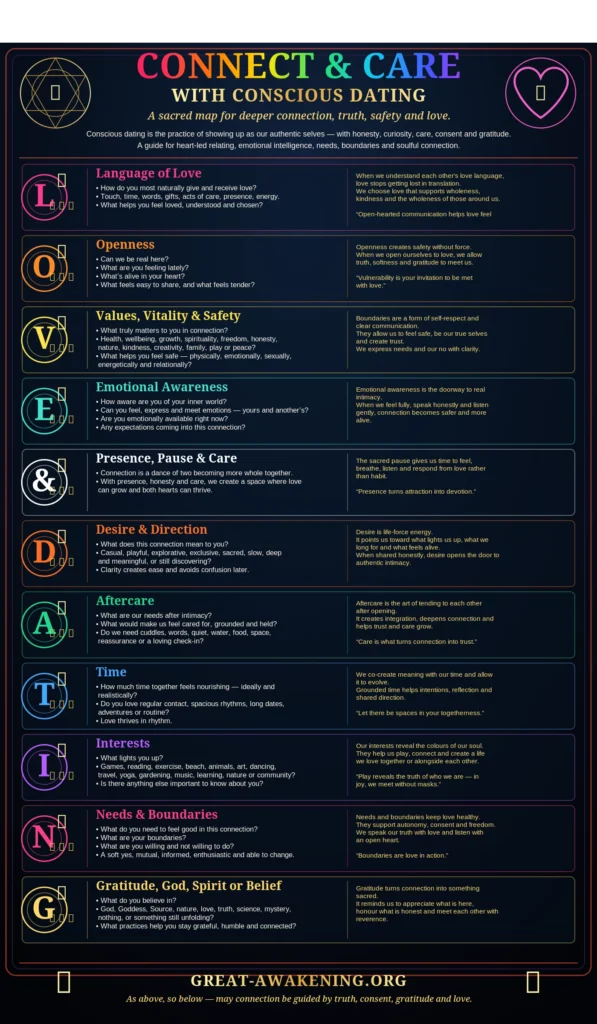
Conscious Dating Tips & Deep Connection Questions
Emotional Awareness, Attraction, Flirting & Conscious Relationship Guidance
A Heart-Centred Relationship Intention
Personally, I’m attracted to someone who is overall aligned with emotional intelligence, health, kindness, presence, vitality, love of nature and animals, being creative and authentic communication.
1. Conscious & Healthy Partner
Someone who values wellbeing naturally — not through perfection, but through awareness and consistency.
- Prioritises gut health, nourishment, sleep, movement and hydration
- Emotionally self-aware and willing to grow
- Calm nervous system and good vagal tone
- Can regulate emotions without excessive chaos or drama
- Enjoys the simple life, grounded and adventurous.
- Loves learning.
- Responsive and considerate with messages
- Enjoys affection, touch, eye contact and presence
- Curious about consciousness, psychology, spirituality or personal growth
- Low addiction patterns: doom scrolling, drugs, alcohol reliance, constant stimulation etc.
- Has passion for intimacy.
- Able to laugh easily and play
Green Flags
- Consistency between words and actions
- Takes accountability
- Good relationships with friends and family
- Speaks respectfully about exes, or can see trauma from the past recreate itself and choices to make better decisions.
- Comfortable discussing feelings without shutting down
- Genuine warmth toward animals, children and elderly people
2. The Peaceful Nervous System Match
This one is underrated and incredibly important.
You can be deeply attracted to someone and still feel dysregulated around them constantly.
- Feels calming rather than addictive
- Helps your nervous system settle
- Doesn’t create confusion or mixed signals
- Is emotionally available
- Can repair conflict maturely
- Responds rather than reacts
- Has healthy pacing in intimacy and attachment
- Makes life feel more spacious, not more stressful
Questions To Quietly Ask Yourself
- Do I feel more grounded after spending time with them?
- Can I fully relax around them?
- Do I feel safe being authentic?
- Are they interested in understanding me?
- Does this connection bring out the best in me?
3. The Family & Future Compatibility Lens
This is wise to think about early, rather than after attachment deepens.
- Relationship with children
- Parenting style if relevant
- Emotional maturity of existing family dynamics
- Lifestyle compatibility
- Financial responsibility
- Desire for community, nature, simplicity, travel and shared values
- Vision of an ideal life
You might prefer no children, older independent children, or exceptionally well-supported and emotionally healthy family dynamics.
4. The Heart-Centred Romantic Match
Someone who values connection itself.
- Loves meaningful conversations
- Enjoys cuddles, affection, intimacy and emotional depth
- Can flirt playfully without manipulation
- Appreciates presence more than performance
- Open to shared growth
- Values emotional safety and mutual admiration
- Wants partnership, not just stimulation
Additional Qualities Worth Considering
Physical & Lifestyle
- Similar energy levels
- Similar cleanliness and hygiene standards
- Shared relationship to health and food
- Similar social needs
- Similar relationship with technology and screens
Emotional
- Repair skills after conflict
- Secure attachment tendencies
- Ability to apologise genuinely
- Not overly defensive
- Curiosity over blame
Spiritual & Philosophical
- Similar values around kindness and integrity
- Growth mindset
- Openness to wonder, beauty and meaning
- Appreciation for nature, art and music
One Subtle But Powerful Dating Insight
Sometimes people with the best nervous systems initially feel less exciting than familiar chaos. Peace can feel unfamiliar if someone has previously experienced trauma bonding or emotional inconsistency.
“Does this connection nourish my life energy over time?”
That question alone can save years.
A Refined Relationship Intention
“I’m drawn to emotionally intelligent, health-conscious, kind-hearted women who value presence, communication, vitality, nature, growth, affection and authentic connection. Someone emotionally available, responsive, grounded and genuinely excited to build a beautiful life together.”
Inspired by:
- Nature
- Creativity
- Emotional awareness
- Wellness
- Music
- Heart-led presence
- Meaningful conversations and silly banter!
Bless your heart ❤
Guy Sohm
What Actually Deepens Connection
Safety • Presence • Curiosity • Attunement • Trust
At Its Core
Connection deepens when safety, presence and curiosity are felt together.
Not effort. Not strategy. Not intensity.
Those often do the opposite.
Real connection is not something we force into being. It is something that grows when the body feels safe enough, the heart feels welcomed enough, and the moment feels spacious enough to reveal what is true.
1. Presence Beats Performance
Whether it’s with a person, nature, a spiritual practice, music, art, land, or your own body — presence creates the doorway.
- Slow down slightly more than feels necessary.
- Feel your breath before you respond.
- Let silence do some of the work.
- Notice what is here before trying to change it.
- Allow the moment to breathe.
Connection deepens when the nervous system feels:
This is especially true in intimate or meaningful connections. When someone feels they do not have to perform, impress, defend, explain or become more than they are, their deeper self begins to emerge naturally.
2. Replace Agenda With Attunement
You already touched this beautifully with the question:
Another potent reframe is:
With people, this creates co-regulation.
With projects, land, art, music, healing work or creativity, it creates flow.
Agenda often says, “I need this to become something.” Attunement says, “I am here to listen to what is already unfolding.”
3. Let Your Body Lead the Way
Deeper connection almost always shows up somatically first.
- Warmth in the chest.
- Softening of the belly.
- Shoulders dropping.
- A slower jaw.
- Spontaneous smiles or sighs.
- More natural breathing.
- A feeling of being able to stay.
If the body is open, connection is already happening — even if the mind has not caught up yet.
The body often knows before the story does. It senses safety, resonance, warmth, contraction, openness, pressure and truth. Learning to listen here is one of the deepest forms of wisdom.
4. Ask Better Questions
Questions can deepen connection without pressure. They invite intimacy rather than trying to manufacture it.
“What would love do here?” is one of those rare questions that gently cuts through strategy, fear, ego and confusion. It returns us to the heart without bypassing the truth.
5. Consistency Is Greater Than Intensity
A little presence, offered often, goes further than rare, big gestures.
This applies to:
- Romantic relationships.
- Friendships.
- Creative projects.
- Spiritual practice.
- Healing work.
- Your relationship with your own body.
- Your relationship with life itself.
Trust builds in small, repeated moments of safety.
It is the message sent again and again:
6. Let Love Be Spacious
Deep connection does not require gripping. It does not need to collapse space, rush certainty, or turn every beautiful moment into a future plan.
Sometimes the most loving thing is to give the connection enough room to breathe.
- Room for honesty.
- Room for nervous systems to settle.
- Room for silence.
- Room for timing.
- Room for truth to reveal itself naturally.
Spacious love often feels calmer, clearer and more sustainable than intense attachment.
7. Come Home to Yourself First
Deep connection is not something you do to another being.
It is something that happens when you are at home in yourself, and others — or life itself — feel invited to meet you there.
When you are connected to your breath, body, values, heart and truth, connection becomes less about chasing and more about radiating.
You become a safe place for life to meet you.
A Gentle Reflection
Is this moment asking you to deepen a romantic connection, a friendship, a creative path, your relationship with yourself, or your relationship with life?
Begin there.
Slowly. Honestly. Lovingly.